



WHAT IS A PASSIVE HOUSE?
A Passive House is a building standard that is energy-efficient, comfortable, affordable, and environmentally friendly at the same time.
A Passive House is designed to significantly reduce energy losses and provide a high level of comfort throughout the year. By making use of passive energy sources, such as solar radiation and heat generated by appliances and equipment, it can reduce heating energy consumption by up to 90% compared with conventional homes, while providing a high level of indoor comfort and improved air quality.
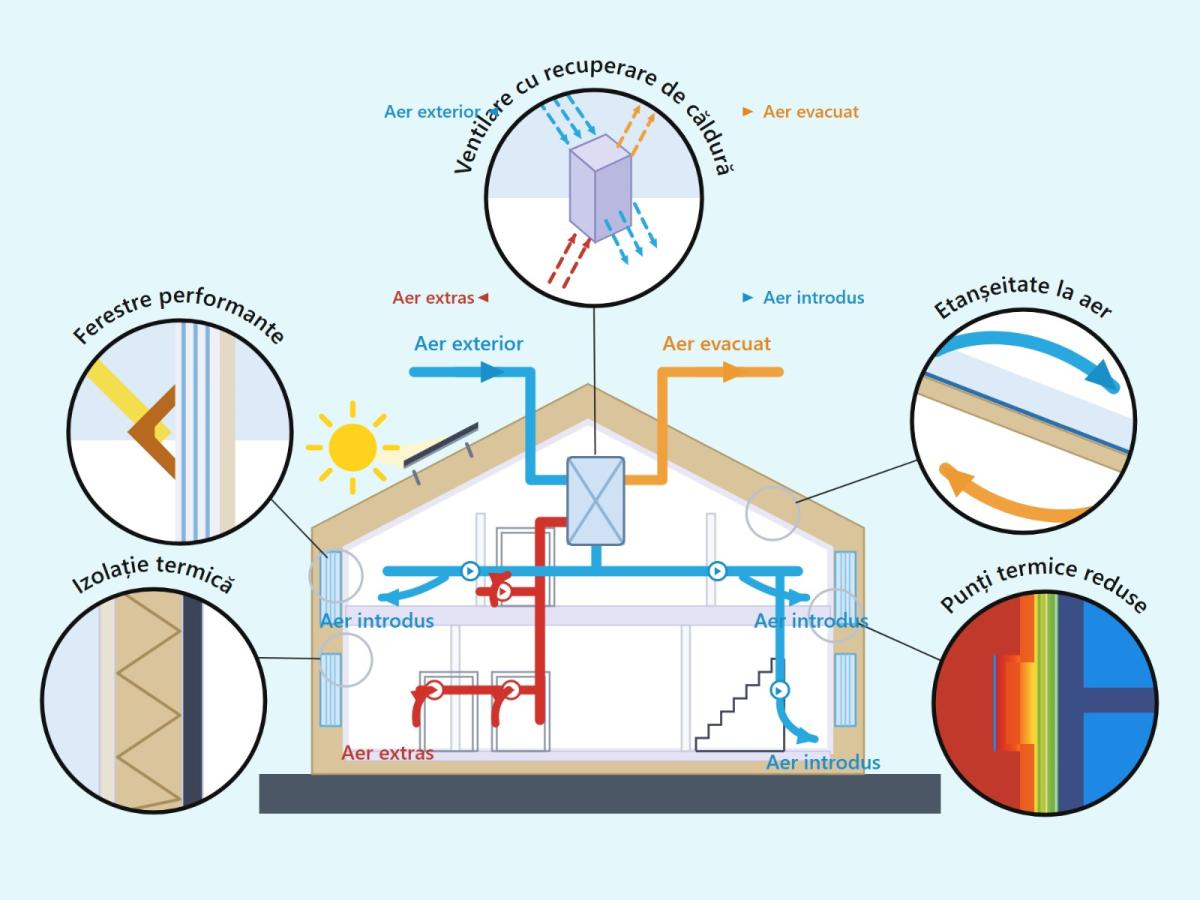
The Passive House standard is based on five essential components:
1. High-performance continuous thermal insulation
The building envelope (walls, roof, foundation) is designed with significant insulation thicknesses to achieve heat transfer coefficients (U-values) below 0.15 W/(m²K).
2. Elimination of thermal bridges
The design must prevent any discontinuity in the insulation layer at structural connections, corners, or fastening elements, as these can cause localized heat losses and increase the risk of condensation.
3. High airtightness of the building envelope
The airtight layer of the building envelope must encompass the entire building. Airtightness is tested using a blower door test, with the standard requiring an air change rate of n₅₀ ≤ 0.6 air changes per hour. Airtightness prevents uncontrolled air infiltration and the associated energy losses.
4. High-performance energy-efficient windows and doors
Triple-glazed windows with thermally insulated frames are used, with a U-value of up to 0.8 W/(m²K), positioned and oriented according to calculations of site-specific solar gains. Solar radiation contributes to reducing the energy demand for space heating.
5. Mechanical ventilation with heat recovery
Due to the high airtightness of the building envelope, a mechanical ventilation system (MVHR) with heat recovery is required. It can recover 75–95% of the thermal energy from the extracted air while simultaneously ensuring good indoor air quality.
What are the benefits of a Passive house?
The main benefits of a Passive House include:
- Maintains a stable indoor temperature – stable indoor temperatures help reduce heat losses during winter and heat gains during the warmer season.
- Prevents cold spots – continuous insulation helps maintain an optimal temperature throughout the house, providing a high level of thermal comfort.
- Reduces heating costs by more than 90% – high-performance insulation and energy-efficient windows minimize heat losses and temperature fluctuations, significantly reducing the energy required for heating and, consequently, heating costs.
- Uses a design adapted to solar exposure – an architectural design that takes advantage of solar energy while incorporating appropriate measures to control solar gains can significantly reduce overheating during summer.
- Can reduce carbon emissions by more than 90% – because a Passive House requires significantly less energy for heating and cooling, emissions associated with conventional energy use can be substantially reduced.
- Reduces external noise – high-performance windows and the building envelope provide not only thermal insulation but also improved acoustic insulation, reducing the transmission of external noise.
- Provides a highly efficient ventilation system – mechanical ventilation enables controlled airflow, contributes to a comfortable indoor environment, and prevents drafts and significant temperature fluctuations. At the same time, filtered air can improve indoor air quality and reduce exposure to airborne allergens.