EcoVoucher: 3,332 families replaced old household appliances with energy-efficient equipment through sessions supported by the European Union

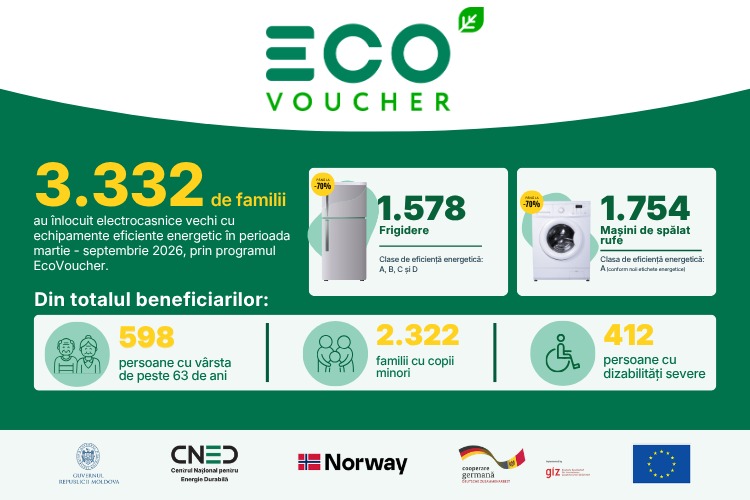
9 October 2026, Chișinău – 3,332 families in the Republic of Moldova benefited from the Household Appliance Voucher Programme (EcoVoucher) through sessions financed by the European Union and replaced old household appliances with new, energy-efficient equipment between March and September 2026.
The beneficiary families purchased 1,578 refrigerators and 1,754 washing machines, using vouchers worth MDL 6,000, which covered up to 70% of the cost of the appliances. Refrigerators, including fridge-freezer models, had energy efficiency classes A, B, C and D, while washing machines were class A, according to the new energy labelling system. All equipment meets energy efficiency criteria and European conformity (CE) standards.
Priority support was provided to families with minor children, households with at least two persons over the age of 63, and persons with severe disabilities. Of the total number of beneficiaries, 2,322 were families with minor children, 598 were persons over the age of 63, and 412 were persons with severe disabilities.
The government EcoVoucher Programme covered all districts of the Republic of Moldova, as well as the municipalities of Chișinău and Bălți and the Autonomous Territorial Unit of Gagauzia. In total, vouchers were issued to beneficiaries in more than 1,400 localities, representing 94% of all localities in the country, while households in more than 1,350 localities, or 91% of the localities of the Republic of Moldova, redeemed their vouchers.
The equipment purchased by beneficiary households through the sessions supported by the European Union is estimated to enable annual electricity savings of approximately 700,000 kWh, equivalent to around MDL 2.6 million. These savings correspond to an estimated reduction of approximately 350 tonnes of CO₂ emissions annually.
“Refrigerators and washing machines are among the largest energy consumers in a household, while older appliances are less energy efficient, which is reflected in household electricity bills. Through EcoVoucher, we help families replace them with more efficient equipment and save money over the long term. The energy label helps people compare appliance consumption and make choices based not only on the purchase price, but also on operating costs. With the support of the European Union, we are making these appliances more accessible to families that need support the most, so that energy efficiency can have a tangible impact on their household budgets,” said Dorin Junghietu, Minister of Energy.
To redeem the voucher, beneficiaries handed over a used appliance of the same type, which was collected and sent for recycling. In this way, the programme contributes to replacing high-energy-consuming appliances and ensuring their responsible management after they are taken out of use.
“The results of this year’s sessions confirm that energy efficiency can bring concrete and immediate benefits to households. By replacing old appliances with energy-efficient equipment, families reduce their energy consumption and monthly expenses while also benefiting from greater comfort. At national level, these savings add up and contribute to more efficient use of energy resources. The results achieved since the launch of the programme demonstrate the impact of a simple and accessible mechanism that can generate real savings for households and for the country,” said Ion Muntean, Director of the National Centre for Sustainable Energy.
“Every family deserves a comfortable home and access to affordable, reliable energy. Through the EcoVoucher Programme, the European Union is helping thousands of families in the Republic of Moldova replace outdated appliances with modern, energy-efficient alternatives. This support goes beyond immediate financial assistance: it helps households reduce their electricity consumption and expenses for years to come. It is a practical example of how EU support translates into lasting benefits for citizens, particularly those who need it most,” said Iwona Piórko, Ambassador of the European Union to the Republic of Moldova.
Since the launch of the EcoVoucher Programme to date, 43,366 large household appliances have been replaced, including 20,639 refrigerators and 22,691 washing machines.
Energy efficiency is one of the most lasting forms of support a household can receive: an efficient appliance keeps lowering the bill for as long as it runs. That is why we see EcoVoucher as an important part of Moldova's response to high energy costs, alongside direct support for vulnerable families. Every kilowatt-hour saved at home also strengthens the country's energy security. For us as implementers, success is measured not only in vouchers issued, but in people's trust in the programme and in more families choosing efficient appliances when they buy on their own," said Marco Buechel, Implementation Manager, E4M project, GIZ.
Replacing an old refrigerator with an energy class A model through the EcoVoucher Programme can generate estimated savings of approximately MDL 160 per month, or MDL 1,920 per year. Compared with the average consumption of beneficiary households, this could represent a reduction of approximately 16% in the electricity bill. Across all appliances replaced through the Programme, the estimated average saving is approximately MDL 780 per year.
Data from the National Centre for Sustainable Energy show that energy savings generated over the entire operating lifetime of the appliances replaced through the EcoVoucher Programme exceed 6.5 million kWh, equivalent to more than MDL 24 million. At the same time, it is estimated that the more than 40,000 appliances installed since the beginning of the programme will generate annual savings of approximately 8.15 million kWh, equivalent to around MDL 30.1 million. This corresponds to a potential reduction of approximately 4,075 tonnes of CO₂ emissions per year.
The Household Appliance Voucher Programme is developed by the Government of the Republic of Moldova with the support of the European Union and implemented by the National Centre for Sustainable Energy (CNED). The 2026 sessions were carried out within the “Energy Efficiency and Renewable Energy for Moldova” (E4M) project, implemented by GIZ together with the Government of the Republic of Moldova, with funding from the Government of Germany and co-financing from the European Union, Norway and Denmark. The sessions referred to in this press release were financed by the European Union.
Images